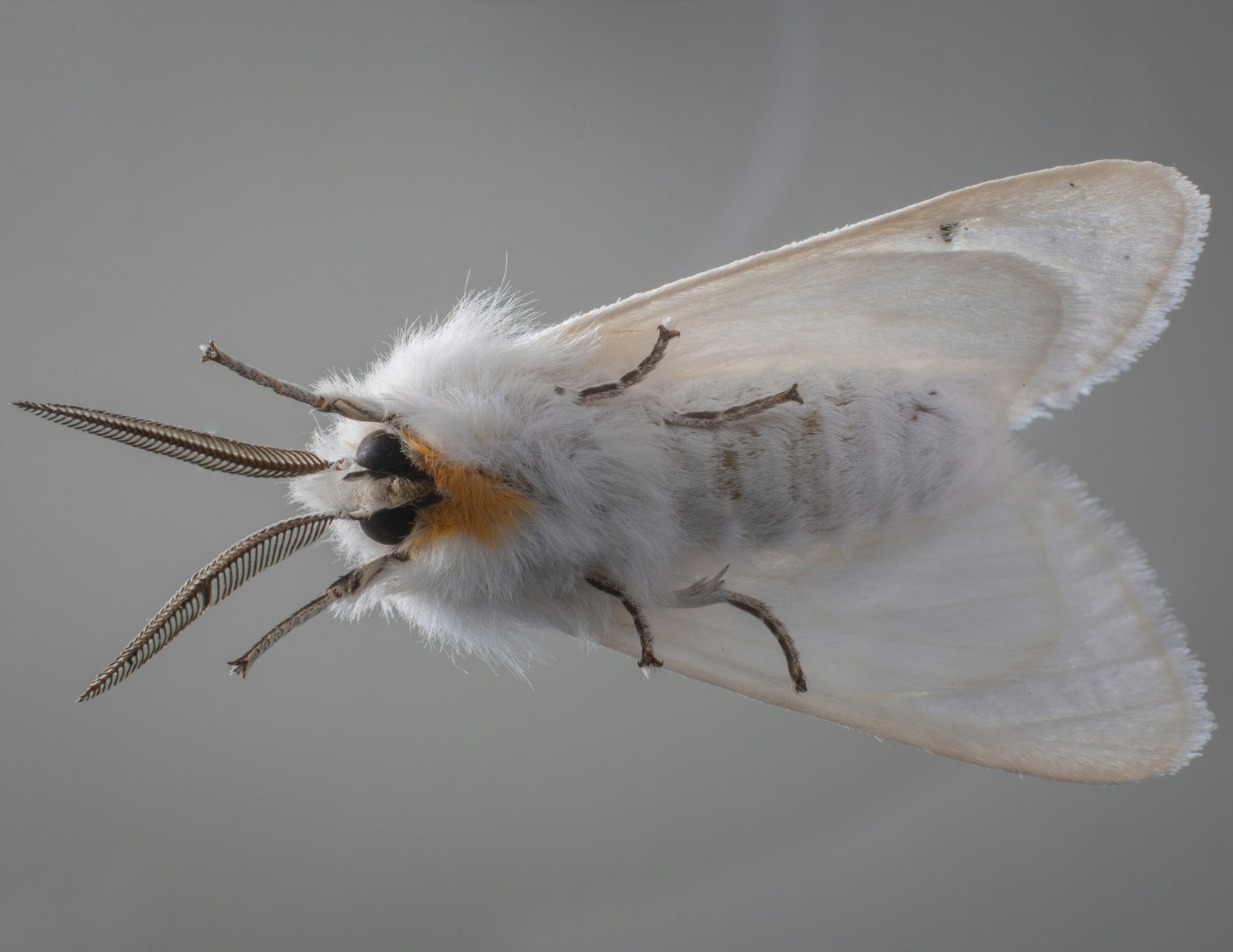
Every summer night, a contest plays out in the dark that most people never notice. Bats sweep through the air hunting insects, and moths try to stay one step ahead. What makes this contest unusual is that it’s fought almost entirely with sound. Understanding how moths escape bats reveals some of the most clever survival strategies in the insect world.
Bats can’t rely on sight to find prey at night, so they use sound instead. Many moths have evolved ways to hear that sound, avoid it, and in some cases answer back. The result is a long-running evolutionary exchange between predator and prey, one that has shaped the bodies and behaviors of thousands of moth species.
How Bats Hunt in the Dark
Most insect-eating bats find their meals through echolocation. A bat sends out a series of high-pitched calls, usually far above the range of human hearing. When those calls strike an object, echoes bounce back to the bat’s ears.
From those echoes, a bat can judge where an insect is, how fast it’s moving, and roughly how big it is. As the bat closes in, it speeds up its calls into a rapid burst. This final stretch of calls helps it track the insect during the last moments of the chase.
For a flying moth, this creates a serious problem. Darkness offers no protection from a hunter that uses sound. A moth can’t simply outfly a bat in open air, so it needs another way to survive.
Moths That Can Hear Bats Coming
Many moths have ears, though they look nothing like human ears. These hearing organs, called tympanal organs, are thin membranes stretched over small air-filled chambers. When sound waves hit the membrane, it vibrates and triggers nerve cells.
Moth ears are often tuned to the same high frequencies that bats use. This gives the moth an early warning system. In many cases, a moth can hear an approaching bat before the bat detects the moth.
The location of these ears varies between moth groups. Some have ears on the thorax, while others have them on the abdomen. Certain hawkmoths detect sound with structures near their mouthparts. This variety suggests that hearing evolved separately in different moth families, each finding its own answer to the same threat.
Dodging, Diving, and Looping
Hearing a bat is only useful if the moth reacts in time. Moths respond differently depending on how loud the bat’s calls are.
When the calls are faint, the bat is still at a distance. Many moths simply turn and fly away from the sound. This quiet retreat may be enough to keep them out of range.
When the calls grow loud and fast, the bat is close and preparing to strike. At this point, many moths switch to dramatic escape moves. They may fold their wings and drop toward the ground, fly in tight loops, or spiral unpredictably. These sudden changes in direction make it hard for a bat to predict where the moth will be.
Remarkably, some moth ears contain only a few sensory cells. That small system is still enough to judge distance and trigger the right response.
Tiger Moths That Click Back
Some moths go beyond listening. Tiger moths are known for producing their own ultrasonic sounds. They use small ridged structures called tymbals, located on the sides of the body. When the tymbals flex, they produce rapid clicks.
These clicks often act as a warning. Many tiger moths carry bitter or toxic chemicals picked up from the plants they ate as caterpillars. Bats that catch one learn that it tastes bad. Over time, bats come to connect the clicking sound with an unpleasant meal and avoid it.
This is similar to how bright colors warn daytime predators about toxic insects. The difference is that tiger moths advertise with sound, which works in the dark.
Jamming a Bat’s Sonar
A few tiger moth species appear to take their clicking one step further. Instead of just warning bats, their sounds seem to interfere with the bat’s echolocation.
When a bat is close to a target, it depends on a clear stream of echoes to track its prey. Rapid clicks from the moth may confuse that stream. The bat may lose track of exactly where the moth is and miss at the last moment.
This kind of acoustic jamming is one of the most surprising defenses in the insect world. It shows how intense pressure from predators can lead to highly specialized solutions.
Hawkmoths and Other Sound Makers
Tiger moths aren’t the only moths that make ultrasound. Some hawkmoths also produce high-pitched sounds when bats approach. They do this by rubbing specialized scales near the tip of the abdomen against other body parts.
This discovery is important because hawkmoths and tiger moths are not closely related. Their sound-making structures are also completely different. That means sound production likely evolved more than once, in separate moth groups, using different parts of the body.
Scientists call this pattern convergent evolution. When unrelated animals face the same challenge, they sometimes arrive at similar solutions on their own.
Quiet Defenses Without Ears
Not every moth can hear, and not every moth makes sound. Some species rely on silent strategies instead.
Luna moths and several of their relatives have long, twisting tails on their hindwings. As the moth flies, the spinning tails create echoes that can draw a bat’s attack away from the body. A bat that grabs a tail may come away with only a piece of wing, while the moth escapes.
Other moths may use the structure of their scales for protection. Research on some earless moths suggests that the dense scales on their wings and bodies can absorb part of a bat’s call. This weakens the echo and makes the moth harder to detect.
Timing also plays a role. Some moths are active during seasons or hours when bats are less common.
Why This Arms Race Matters
The interaction between bats and moths is one of the clearest examples of an evolutionary arms race. As bats improved their hunting skills, moths developed new ways to survive. Each side has influenced the other for millions of years.
This relationship also matters for ecosystems. Bats help control insect populations, including crop pests. Moths pollinate plants and serve as food for birds, bats, and many other animals. Changes that affect one side of this relationship can affect the other.
Human activity adds pressure to both groups. Artificial light at night, habitat loss, and pesticide use can change where moths fly and how exposed they are to predators.
Listening for the Contest Yourself
Humans can’t hear most bat calls, but it’s still possible to witness this contest. On a warm evening, watch the area around a streetlight or a garden with native plants. You may see moths suddenly swerve, drop, or change direction for no obvious reason.
Some nature centers and hobbyists use bat detectors, devices that convert ultrasonic calls into sounds people can hear. Listening with one of these tools offers a new way to experience the night.
The next time a moth darts out of sight, there’s a good chance it heard something you couldn’t.
Frequently Asked Questions
Can moths really hear bats?
Yes. Many moths have hearing organs called tympanal organs that are sensitive to the high-pitched calls bats use for echolocation.
Do all moths have ears?
No. Many moths can hear, but some species lack ears entirely. These moths often rely on other defenses, such as wing tails, sound-absorbing scales, or flying at times when bats are less active.
Why do tiger moths make clicking sounds?
Many tiger moths click to warn bats that they taste bad. Some species may also use their clicks to interfere with a bat’s echolocation.
What do moths do when they hear a bat?
When a bat is far away, many moths turn and fly away from the sound. When a bat is close, they may dive, loop, or drop toward the ground to avoid capture.
Can people hear bat calls?
Most bat echolocation calls are too high for humans to hear. Special devices called bat detectors can convert these calls into sounds within the human hearing range.