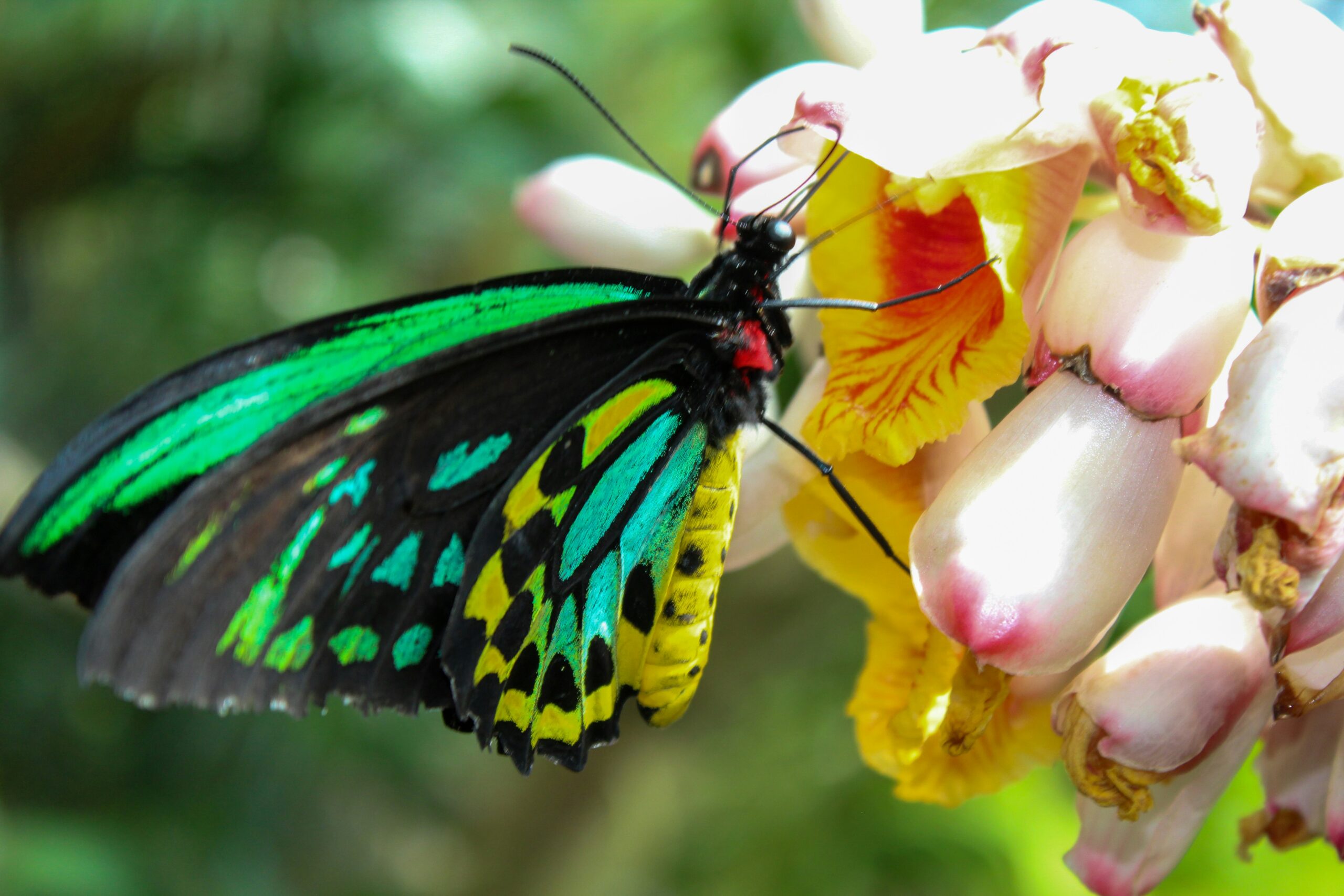
The natural world holds many small wonders, but few creatures match the beauty of butterflies and moths. Among them, stunning Lepidoptera species stand out for their vivid colors, intricate wing patterns, and graceful flight. Lepidoptera is the order that includes butterflies and moths, and it contains more than 160,000 known species. Some live deep in tropical forests, while others live in urban areas and are seen in gardens and parks.
Their wings often look like living art. Bright blues shimmer in sunlight; metallic greens flash when they move. Some even mimic leaves, while others have eyespots to startle predators. These remarkable adaptations make Lepidoptera both beautiful and fascinating.
Below are ten species that capture the imagination of nature lovers, photographers, and scientists alike.
Morpho Butterfly (Morpho sp.)
Morpho butterflies are a group of approximately 30 species. They are one of the world’s most famous butterflies. Their wings are large and often shiny blue. This color does not come from pigments; instead, it is made of microscopic scales that reflect light, creating the brilliant glow.
Morpho butterflies live mainly in the tropical forests of Central and South America. When they fly, the flashes of blue stand out against the dark green forest. When they land, they close their wings and reveal a dull brown underside with eye spots. This sudden change helps them hide from predators.
Watching a Morpho glide through the forest is magical. The contrast between its bright upper wings and hidden underside is a perfect example of nature’s clever design. Surprisingly, a few species are not blue, but white. These are called “White morphos” and are found in the mountains of Central America.
Glasswing Butterfly (Ithomiini)
Glasswing butterflies are a group of butterflies that have transparent wings. They typically fly in the rainforest understory, land on plant leaves, and sometimes visit flowers. They are difficult to see because they only have a few opaque wing markings.
The clear sections of the wings lack the colored scales found on most butterflies, and instead, light passes straight through them. This transparency helps the butterfly blend into its surroundings, making it harder for predators to track it in the forest understory, which is dimly lit.
Glasswing butterflies live in Central and South America. Surprisingly, several other butterfly groups share transparent wings. Another butterfly genus, Haetera, also lives in the forest understory but typically lands on dead leaves on the ground. They are often very sensitive to movement, so it is difficult to approach them when photographing them.
This simple yet elegant design makes these butterflies among the most stunning Lepidoptera in the world.
Sunset Moth (Chrysiridia rhipheus)
The Sunset Moth looks more like a Swallotail butterfly than a typical moth. Its wings shine with vivid colors, a palette that includes nearly all colors of the rainbow. Bright red, green, orange, and blue form a beautiful pattern that glows in sunlight.
This species lives in Madagascar. Unlike many moths, it is active during the day. Its colorful wings are not created by pigments but by microscopic structures that reflect light in different ways.
The Sunset Moth’s beauty has fascinated scientists for centuries. When it spreads its wings in full sunlight, the colors shift. Because of its beauty, collectors have sought these moths, and the species is declining mainly due to habitat loss.
Peacock Butterfly (Inachis io)
The Peacock Butterfly is known for the large eye spots on its wings. These markings resemble the eyes on a peacock’s tail feathers.
When the butterfly opens its wings, the bright red, blue, and purple colors and its bold eyespots suddenly appear. This display can startle birds and other visual predators. The startle strategy often gives the butterfly enough time to escape.
Peacock butterflies live across Europe and parts of Asia. They prefer gardens, woodlands, and open fields filled with flowers, and the larvae feed on nettle. During spring and summer, they visit nectar-rich plants and help pollinate them.
One of the first butterflies I caught was a Peacock butterfly in the mountains of central Japan. I was 6 years old, and I still remember that moment when I saw it for the first time.
Madagascan Moon Moth (Argema mittrei)
The Madagascan Moon Moth looks almost mythical. Its yellow wings stretch wide, and long tails trail behind it as it flies.
This moth belongs to the Saturniidae family, which includes many large moths. Adults live only briefly and do not eat. Their main purpose is reproduction. Through research in our lab, we have found that the long tails are twisted to create a “dummy” moth behind the true moth as it flies. Hunting bats are fooled and attack the tails, thereby allowing the moth to escape.
Despite their short adult life, these moths are unforgettable. Their wings glow softly under moonlight, which is how they earned their name.
Atlas Moth (Attacus atlas)
The Atlas Moth is one of the largest moths on Earth. Its wingspan can reach nearly a foot across. When fully spread, the wings display rich brown, orange, and cream patterns.
The tips of the wings resemble a snake’s head. While scientists are still not certain, it is thought that this mimicry helps scare away predators.
Atlas moths live across Southeast Asia and prefer tropical forests where their host plants grow in abundance.
Even though they look powerful, adult Atlas moths live for only a few days. Like many other species in the family Saturniidae, they do not have functioning moths and thus cannot feed much as adults. They spend that time searching for mates before completing their life cycle.
Zebra Longwing Butterfly (Heliconius charitonia)
The Zebra Longwing stands out as an unusual butterfly with its bold black-and-yellow stripes. The pattern resembles a zebra’s coat, which inspired its name.
This butterfly lives in the warm regions of the Americas, including Florida and parts of Central and South America. It flies slowly and gracefully, often gliding through gardens and forests. Caterpillars feed on Passionflower, and can often be found in gardens searching for host plants and nectar. Zebra longwings are a species of Heliconius, a genus of butterflies that can live for many days. These butterflies are known to have the largest brains among butterflies.
Their striking stripes and calm flight make them a favorite subject for photographers and nature observers.
African giant swallowtail (Papilio antimachus)
Giant African Swallowtail (Papilio zalmoxis) Rosy Maple Moth (Dryocampa rubicunda)
The Rosy Maple Moth is a medium-sized, pink-yellow fuzzy moth. Its colors make it one of the most charming moths in North America.
Despite its playful appearance, this moth has a unique life cycle. Its caterpillars feed on maple leaves and are sometimes called green-striped mapleworms.
The adult moth usually rests during the day and becomes active at night.
When people first see this moth, they often do not realize that it is a moth. Its soft colors and fuzzy body make it one of the most adorable Lepidoptera species.
Why Lepidoptera Matter
Butterflies and moths do more than brighten landscapes. They play a crucial role in ecosystems.
Many species pollinate flowers while feeding on nectar. This helps plants reproduce and maintain biodiversity. Caterpillars also serve as food for birds, reptiles, and other animals.
Because Lepidoptera are sensitive to environmental changes, scientists often study them to measure ecosystem health. When butterfly populations decline, it can signal problems such as habitat loss or climate shifts.
Protecting these insects helps protect the larger natural world.
The Beauty of Small Creatures
Lepidoptera remind us that beauty often appears in small forms. Their wings carry colors and patterns that rival the finest artwork.
Some species shimmer with metallic blues. Others blend into leaves or tree bark. Each one has evolved unique traits to survive.
Carefully examining these creatures and being observant of their presence can encourage people to look more closely at the natural world around them.
Frequently Asked Questions
What does the word “Lepidoptera” mean?
Lepidoptera is the scientific name for the order that includes butterflies and moths. The name comes from Greek words meaning “scale wings,” which describes the tiny scales that cover their wings.
What is the most beautiful Lepidoptera species?
Beauty is subjective, but many people consider the Morpho, Sunset Moth, and Glasswing Butterfly among the most stunning Lepidoptera species. Many small moths are incredibly beautiful and metallic. Most people do not realize this because these moths can be tiny. Using a macro lens, one can often see the beauty in them, and I highly encourage you to look at the small moths around us.
How many Lepidoptera species are there?
Scientists have identified more than 160,000 species of butterflies and moths. Many more may remain undiscovered in remote regions.
Why do butterflies have bright colors?
Bright colors help butterflies attract mates, warn predators, control body temperature, or blend into their surroundings, depending on the species.
Are moths as important as butterflies?
Yes. Despite the often negative perception that surrounds moths, they are vital to the environment and play a key role in food chains. Many plants rely on moths for pollination, especially those that bloom at night.